
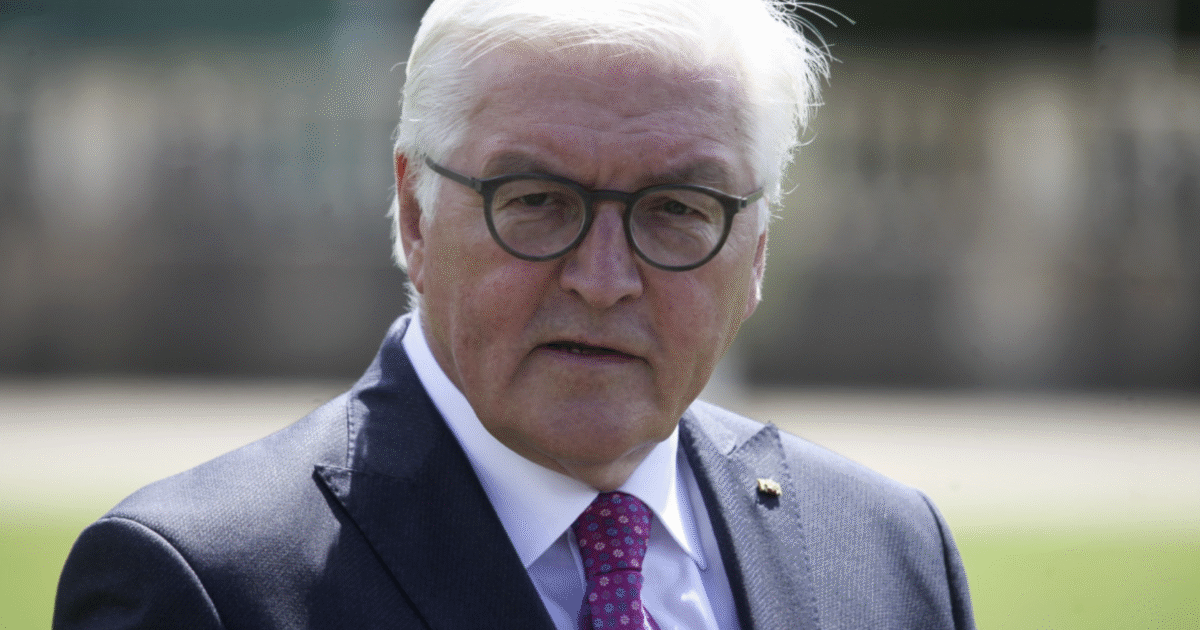

A sharp and unusually public rift has opened in transatlantic relations, as German President Frank-Walter Steinmeier delivered a blunt critique of the ongoing war with Iran, marking one of the most direct European challenges to American leadership in recent years. His remarks have ignited debate not only about the conflict itself, but about Europe’s future path in a rapidly shifting global order.
Speaking before diplomats in Berlin, Steinmeier, a member of the Social Democratic Party (SDP), described the war as a “politically disastrous mistake,” arguing that it represents a fundamental break from established norms. His tone stood out in a continent where many leaders have chosen more cautious language.
“Our foreign policy does not become more convincing just because we do not call a breach of international law a breach of international law,” Steinmeier said. He added that, in his view, the war is “contrary to international law.”
The German president went further, questioning the justification for the conflict. He argued that claims of an imminent Iranian threat to U.S. targets “did not hold water,” framing the war as avoidable rather than inevitable.
Steinmeier’s intervention is significant not because of his formal powers—which are largely ceremonial—but because of the signal it sends within Germany’s political establishment. His comments reflect growing unease across Europe as the consequences of the conflict ripple outward.
At the same time, the response from Berlin has been far from unified. Chancellor Friedrich Merz has taken a more cautious approach, avoiding explicit legal judgments while acknowledging that the war raises “major questions” about Europe’s security.
This divergence highlights a broader tension within Europe: how to balance traditional alliances with an increasingly independent strategic outlook. While some leaders remain aligned with Washington, others are beginning to openly question the costs of that alignment.
From a national-conservative perspective, the episode underscores a deeper problem—Europe’s long-standing dependence on external powers for its security and strategic direction. For decades, many European governments have relied heavily on the United States, often at the expense of their own sovereignty.
Now, voices like Steinmeier’s are calling for a recalibration. He argued that Germany must reduce its reliance on the U.S., particularly in defense and technology—areas he described as central to national power.
“Germany has to apply the lessons learned from excessive dependencies,” he said, referencing the country’s earlier reliance on Russian energy. The implication is clear: dependence, whether on Moscow or Washington, carries risks.
This shift is already being felt in economic terms. Trade patterns between Germany and the United States have come under strain, with tariffs and policy disagreements reshaping long-standing relationships.
At the same time, China has re-emerged as Germany’s leading trading partner, highlighting the complexity of Europe’s global positioning. For critics of globalization, this raises further questions about whether Europe is merely swapping one dependency for another.
Steinmeier also pointed to the technological domain as a critical battleground. He warned that Europe’s reliance on U.S.-based technology companies leaves it vulnerable, both economically and politically.
“Europe as a technology hub has talent, markets, opportunities,” he said, urging the continent to build its own capabilities rather than depend on external providers. This call aligns with a broader push among European leaders for greater digital sovereignty.
The backdrop to all of this is the war with Iran itself, which has entered a volatile phase with global consequences. Energy markets have been shaken, supply chains disrupted, and security concerns heightened across multiple regions.
For many in Europe, the conflict is not just a distant geopolitical event but a direct economic and strategic challenge. Rising energy costs and instability in key trade routes have brought the realities of global conflict closer to home.
Yet the debate unfolding in Berlin is about more than the war. It reflects a growing recognition that Europe must define its own path rather than simply follow the lead of larger powers.
Steinmeier drew a striking comparison to Germany’s break with Russia following the 2022 invasion of Ukraine. He suggested that relations with the United States may now be entering a similarly irreversible phase.
“Just as there will be no going back in relations with Russia, there will be no going back in transatlantic relations to before January 20, 2025,” he said, referring to the start of President Donald Trump’s second term.
Such language would have been unthinkable just a few years ago. It reflects the extent to which global alliances are being re-evaluated in light of shifting priorities and pressures.
Importantly, Steinmeier stopped short of directly criticizing Israel, focusing his remarks instead on broader strategic and legal concerns. This careful positioning reflects the delicate balance European leaders are attempting to maintain.
Within Germany, the president’s comments are likely to intensify domestic debate. The governing coalition itself is divided, with center-left voices more critical of the war than their conservative counterparts.
Across Europe, similar divisions are emerging. Some governments emphasize solidarity with traditional allies, while others prioritize national interests and economic stability.
From a populist perspective, this moment reinforces a key argument: that nations must retain the ability to make independent decisions based on their own interests, rather than relying on external frameworks or assumptions.
The calls for greater autonomy in defense and technology are part of a broader shift toward reasserting national control. Whether this leads to a more cohesive Europe or further fragmentation remains to be seen.
What is clear is that the war in Iran has accelerated existing trends. It has exposed vulnerabilities, tested alliances, and forced governments to confront difficult questions about their future direction.
For Germany, the challenge now is translating rhetoric into policy. Reducing dependency on the United States will require significant investment and political will—neither of which can be taken for granted.
For Europe as a whole, the stakes are even higher. The continent stands at a crossroads between continued reliance on global structures and a more self-directed path rooted in sovereignty.
As the conflict continues, the debate sparked by Steinmeier’s remarks is unlikely to fade. Instead, it may mark the beginning of a broader reassessment of Europe’s place in the world.
In that sense, the significance of his speech extends beyond immediate politics. It signals a shift in mindset—one that both supporters and critics will be watching closely in the months and years ahead.
The post German President Calls Trump’s Iran War “Illegal” and a “Disastrous Mistake” appeared first on The Gateway Pundit.