


Iran is both a crude-oil exporter and a net importer of refined petroleum products, including gasoline, diesel, and jet fuel, because its domestic refining capacity was already insufficient before the war.
Now that refining facilities are being struck, Iran will be able to produce even less refined fuel.
Iran holds fewer than 90 days of petroleum reserves. With production and distribution facilities now under sustained attack and no clear prospect of resupply at prewar prices, the regime faces growing resource constraints.
The closure of the Strait of Hormuz has effectively halted not just exports but maritime trade in the region, meaning Iran cannot easily import refined products either.
Iran depends on shipments moving through the Strait for gasoline imports, estimated at hundreds of thousands of barrels per day. The U.S. and Israeli strikes are not only creating shortages inside Iran but might also convert the country into a net oil importer.
Despite Iran’s membership in BRICS, there are no visible signs that any member state is moving to intervene militarily or economically on its behalf.
On day nine of the war, Israel crossed a significant threshold, striking Iran’s oil infrastructure for the first time.
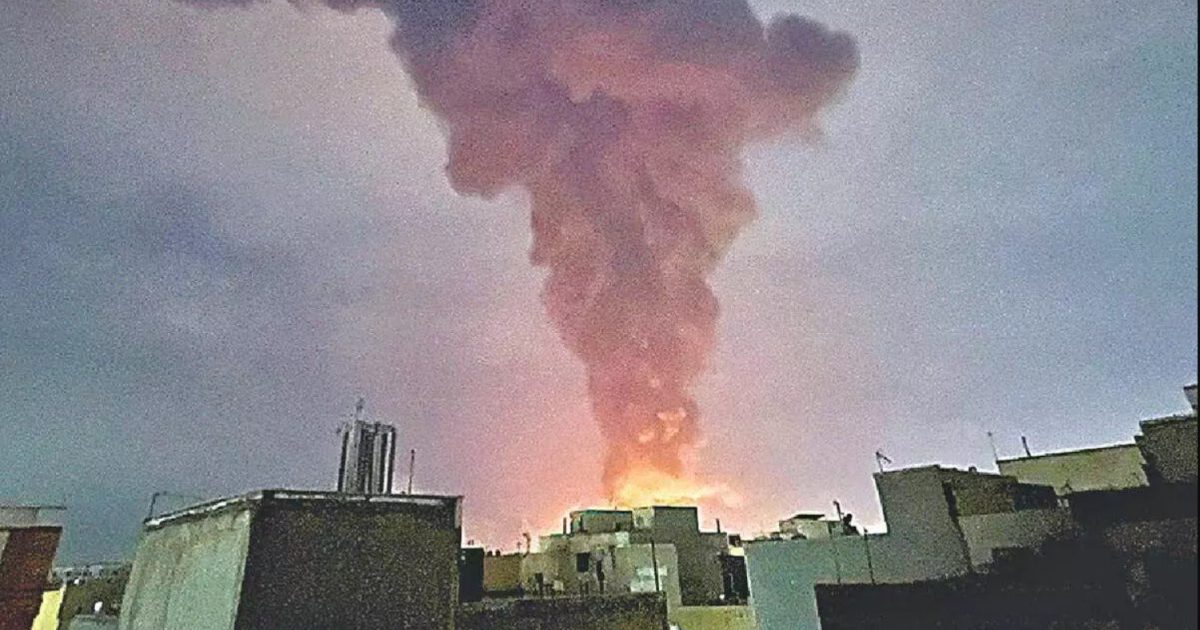
On the night of March 7, the Israeli Air Force hit more than 30 fuel depots and refining facilities in and around Tehran, including the Aghdasieh oil warehouse in northeast Tehran, the Tehran refinery in the south, the Shahran oil depot in the west, and a depot in the city of Karaj in neighboring Alborz Province.
Witnesses reported oil from the Shahran depot leaking into nearby streets. Large fires burned through the night, visible for miles and blanketing the capital in thick black smoke. Residents reported oil-saturated raindrops falling on the city the following morning.
For years, Iran’s power across the Middle East has been built on oil revenue. That money funds the IRGC, Hezbollah, Hamas, and the broader network of proxy forces operating across the region.
Destroying the infrastructure that produces and distributes that revenue collapses the financial engine that has sustained Iran’s regional strategy.
The IDF framed the strikes as militarily justified. Sources confirmed that the targeted facilities are directly connected to Iran’s military-industrial complex, stating that Iranian military organs, including missile units launching strikes at Israel and across the region, depend on fuel drawn from these depots.
The oil strikes were part of a wider campaign that continued across multiple target sets over the weekend. Israeli and American forces struck more than 300 targets inside Iran and another 170 in Lebanon.
The IDF reported killing five IRGC commanders based in Lebanon and destroying Hezbollah infrastructure concentrated in the south and the southern suburbs of Beirut.
Weapons-production facilities near Parchin, south of Tehran, were hit, including factories producing explosives for ballistic-missile warheads and complexes assembling missile components.
The IDF also stated that it struck Iran’s two most central ballistic-missile production sites and destroyed 16 IRGC Quds Force aircraft at Mehrabad International Airport, which it identified as a hub used to transfer weapons and cash to Hezbollah and other proxy forces across the region.
Earlier in the conflict, airstrikes targeted an underground bunker built for Khamenei, with reports indicating that several entrances had been concealed beneath schools, mosques, hospitals, and sports stadiums.
Iran responded on multiple fronts. The IRGC announced that missiles struck the Haifa refinery in Israel in retaliation for the attack on the Tehran refinery.
The spokesman for the Khatam al-Anbiya military headquarters warned that continued strikes on Iranian oil infrastructure would trigger retaliatory attacks on energy infrastructure across the region. Iran also struck a desalination plant in Bahrain, drawing Gulf states deeper into the conflict.
The region depends on desalinated water for much of its drinking supply, making infrastructure of that kind a sensitive target.
Iran’s political succession proceeded in parallel with the military campaign. Following the killing of Supreme Leader Ali Khamenei on the first day of the war, Iran’s religious leadership selected his son Mojtaba Khamenei as his successor.
The 56-year-old has close ties to the Revolutionary Guard, signaling continuity of the hard-line posture his father maintained for 37 years.
Prime Minister Netanyahu responded by stating that Israel would target the new leadership and those involved in the selection process. Netanyahu said Israel has an organized plan with many surprises to destabilize the regime and enable change.
As of March 9, Iranian state media have confirmed that the new supreme leader, Mojtaba Khamenei, has been wounded, although the extent of his injuries is not yet known.
China faces its own exposure. As the world’s largest crude-oil importer, taking in roughly 10 to 11 million barrels per day, China has relied heavily on Iranian crude supplied at a discount through sanctions-busting arrangements.
Its combined strategic and commercial petroleum reserves are estimated at between 1.2 and 1.3 billion barrels, equivalent to approximately 75 to 80 days of consumption at current rates.
Those reserves cannot be replenished at equivalent cost. Once drawn down, China must reenter a market at war-premium prices, with Iranian supply disrupted, Middle Eastern flows broadly constrained, and Russian crude subject to its own sanctions pressure.
The United States faces no comparable constraint. Having become a net energy exporter in 2019, American producers benefit directly from elevated global oil prices.
Shale operators in the Permian Basin and LNG exporters gain margin as Europe and Asia compete for available supply, often at premium prices.
The structural asymmetry is significant. High oil prices impose a sustained cost on the world’s largest energy importer while generating revenue for the world’s largest energy exporter.
The post US-Israeli Strikes Destroying Oil Infrastructure, Converting Iran Into a Net Petroleum Importer appeared first on The Gateway Pundit.