
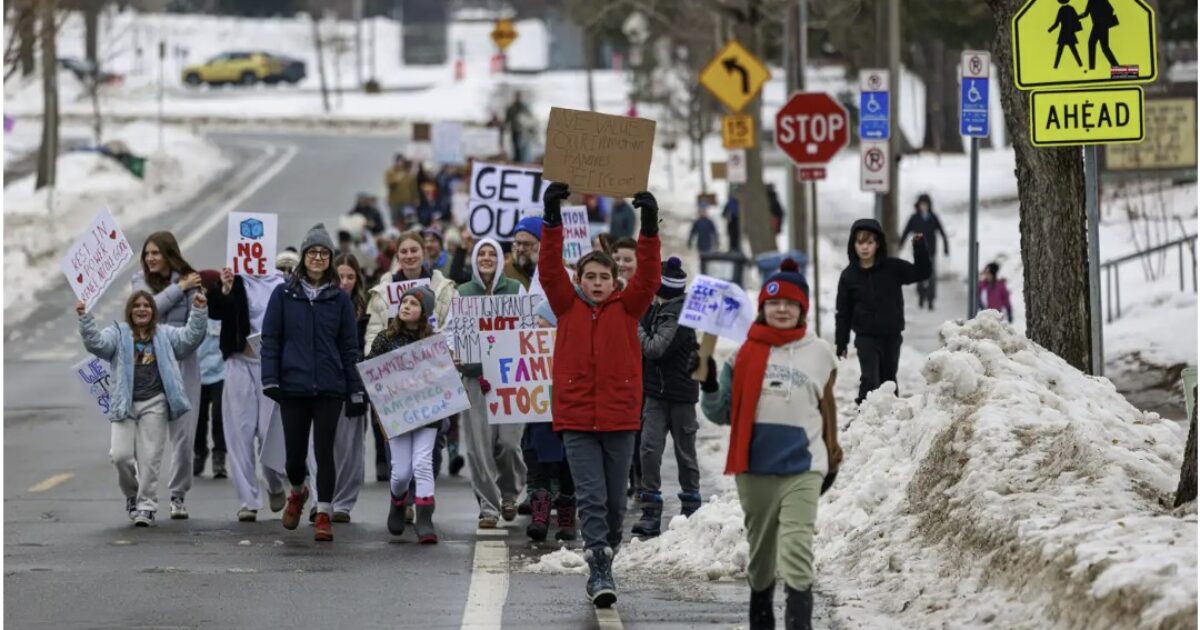


In school districts across the country, controversy has become something to manage rather than teach. Student journalists describe prior review policies that allow administrators to pull articles before publication.
Classroom discussions on immigration enforcement, abortion law, policing policy, or foreign affairs are redirected, softened, or shut down entirely. Administrators rarely deny the pattern.
The reasoning is predictable: controversy generates parent complaints, school board conflict, and reputational risk. In a politically polarized environment, stability becomes the primary goal.
K–12 schools, however, cannot function as public relations entities whose main objective is avoiding phone calls from parents. For too long, education has revolved around the vested interests of adults—administrators protecting district image, teachers protecting contracts, parents protecting political comfort—rather than the intellectual development of students. That structure must change.
It is easy to blame teachers for indoctrinating students, a charge often made by conservatives against progressive educators. There are certainly isolated cases in which political bias shapes instruction.
I have not experienced systemic indoctrination in my own education, and my school district has treated me well. I have had strong teachers, serious coursework, and an environment that allowed me to grow. I am grateful for that.
At the same time, gratitude does not absolve one of the obligation to criticize structural problems when they exist.
The deeper issue is not that politics is being aggressively taught, but that because parents are intensely reactive to politics in schools, politics is often not taught at all.
I live in a predominantly Jewish, largely pro-Israel community. During the Israel-Gaza war, a student newspaper published an article discussing the devastation in Gaza. The image accompanying the piece sparked backlash. Parents objected to the photo selection, framing it as biased. The controversy escalated quickly.
Instead of using the moment to teach students how media framing works, how images shape perception, and how to analyze war reporting critically, the message that followed was clear: certain topics are too sensitive.
Politics shifted from debate to avoidance.
Later, when I attempted to publish a pro-ICE article in a school setting, the response was not that my argument lacked evidence or balance. Rather, the topic itself—immigration enforcement—was too controversial.
Whether someone supported or opposed ICE became irrelevant. The entire subject was treated as radioactive.
Civic education does not improve when controversial topics disappear. Students cannot learn to evaluate arguments they are never permitted to hear. They cannot practice disagreement if disagreement is institutionally discouraged.
From an administrative standpoint, the calculation makes sense. District leaders face public pressure, social media scrutiny, and potential backlash from the board. Avoiding controversy protects stability. Yet stability achieved through avoidance produces intellectual stagnation.
Schools exist to educate, not to neutralize.
I would rather sit in a classroom where I strongly disagree with the prevailing viewpoint than sit in one where no viewpoint is allowed. Exposure to arguments forces students to sharpen their own reasoning. Silence prevents that sharpening process entirely.
When administrators prevent discussion because the topic might generate complaints, they replace intellectual rigor with risk management.
The effects are visible beyond the classroom. When I watch ICE protests organized by high school students across the country, I see energy but not depth. I see slogans but not statutory analysis. I see passion but not understanding of how federal authority is structured, how immigration law is written, or how executive agencies operate.
That is not entirely the students’ fault. It is the predictable outcome of an education system that avoids the substance of controversial policy debates.
Civic engagement without civic literacy becomes performance. Students march, chant, and post, but many cannot explain the legal framework they are protesting.
If immigration enforcement, policing authority, or foreign policy discussions are considered too controversial for classrooms, students will form opinions without structured guidance.
A functioning democracy requires citizens who can analyze arguments they oppose, understand legal structures they criticize, and articulate positions grounded in fact rather than impulse. That capacity must begin in K–12 education. Schools cannot prepare students for civic life while shielding them from civic substance.
If controversy is inevitable in public life, then controversy must be part of public education. The alternative is a generation fluent in outrage but unfamiliar with the foundations of the policies they debate.
The post GREGORY LYAKHOV: Public Schools Must Stop Stifling Students’ Political Views appeared first on The Gateway Pundit.