


A small wooden sign reading “Jungle School of Medicine Kawthoolei” hangs on a bamboo frame beside a vegetable garden, with a row of bamboo buildings behind it that serve as a hospital and classrooms.
Kawthoolei is the Karen people’s term for their homeland, a region of eastern Burma (Myanmar) where Karen resistance forces have operated for decades. The Karen National Union (KNU) began its armed struggle shortly after independence, formally launching its war against the Burmese government in 1949.
For many years it was a lonely fight, with isolated ethnic groups resisting successive military juntas. But since the 2021 coup, war has spread across the entire country and intensified dramatically in the ethnic areas.
The Jungle School of Medicine Kawthoolei (JSMK) is part of the Free Burma Rangers (FBR), which trains medics to work in front-line areas, under fire, where no other aid exists. One anxious female student in the advanced course described why she came to JSMK. “I was in the car with a civilian wounded by a Burma Army attack,” she said. “There was blood everywhere, but I didn’t know what to do.” She paused, reliving the trauma. “So I decided to come here and get training so I can return to my village and help people.”
But during her training, the advanced medic student received word that her village was under attack and residents were fleeing. By the time she completes the course, the Burma Army may have occupied the ground where her home once stood, and her parents and relatives may have joined the 3.5 million people already internally displaced in Burma, about seventy-percent of whom have been uprooted since the 2021 coup that overthrew the democratically elected National League for Democracy government.
All the trainees have similar stories about why they came for training. At this point, nearly everyone in the ethnic states has been displaced, has seen friends or relatives killed or wounded, or all of the above, and they want to help protect their land and their people against the Burma Army.
JSMK is located beside the Free Burma Rangers (FBR) training camp, where more than 200 basic and advanced Rangers are learning about 40 skills, including land navigation, medical care, security, reporting, the Good Life Club children’s program, video, and photography. The group’s mission, according to founder David Eubank, a former U.S. Special Forces officer and Ranger-qualified soldier, is to bring medical help and relief to front-line areas where no other organizations are willing to go.
They treat the wounded, care for displaced civilians, document abuses and war crimes committed by the Burma junta, and train Ranger teams that operate across the country saving lives and, as Eubank put it, “showing God’s love.”
FBR is not a typical missionary organization. They believe that by risking their lives alongside the people they serve, they best live out Jesus’ teaching: “That ye love one another; as I have loved you, that ye also love one another.” Neither the handful of foreign instructors nor the nearly 1,000 Ranger teams comprised of countless ethnic minority groups, working throughout Burma receive a salary. Their slogan reflects that commitment: “Do this for love.”

Eubank said that to be a ranger, one must understand safety and how to survive ambushes. The emphasis, however, is on leadership, servanthood, humility, and love. “The three rules are simple,” he said. “Do this for love, be literate, and don’t run if the people you’re helping can’t run.” Although the organization is driven by Christian principals, Rangers come from many backgrounds, including Christians, Buddhists, agnostics, and animists.
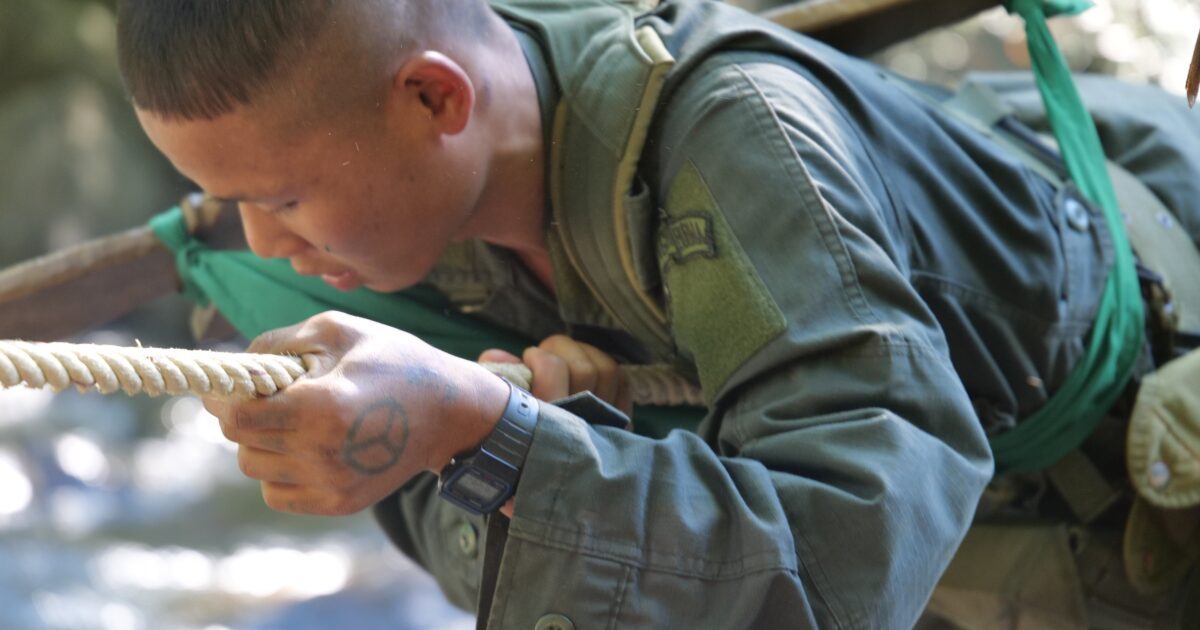
Earlier this week, the students took part in a field training exercise (FTX). Throughout the night, artillery simulators and blank rounds echoed through the jungle, creating the stress of combat as the trainees navigated in darkness from station to station, treating classmates acting as the wounded. At one station they had to stop a sucking chest wound; at another they applied a tourniquet.

Tourniquets are among the most important tools they carry, because a soldier shot on the front line can bleed out in minutes, long before reaching a casualty collection point where advanced medical personnel can intervene.
Field exercises often run through the night, and sometimes for two full days with no sleep and no food, forcing students to push through exhaustion, discomfort, and hunger, realities they will likely face on the battlefield. This particular exercise ended around 1:30 a.m. The next morning, at 5:30, the students turned out for physical training (PT).
They generally have one formal PT session each morning, consisting of running, push-ups, pull-ups, planks, man-carries, and similar exercises. In the late afternoon they usually have a second PT session, carrying firewood or sacks of food and medicine through the jungle for up to an hour and a half.

Before dinner, they bathe in the river, which becomes uncomfortable in December when mountain temperatures can drop to 51°F (11°C). After dinner, they return to class for more training. The full basic course lasts about three months. Advanced students return for another session, and a select few are chosen for the one-year medical program at JSMK.Top of Form
The rainy season has just ended in Burma, and the junta generally launches major offensives once the roads dry. Reports now indicate a buildup of government troops in reinforced positions on the mountaintop, and they are expected to push forward soon to retake the town below.
Working with Karen resistance forces, FBR sent a reconnaissance team to map the area, locate enemy positions, assess troop strength and weapons, and determine likely avenues of attack. They also had to identify safe locations for casualty collection points (CCPs). These points must be reachable by the aid-and-litter teams who carry the wounded from the front line on hammocks suspended from bamboo poles, yet not easily visible from the air.
The CCP must be concealed and, whenever possible, placed under overhead cover because the Burma Army routinely scouts for and deliberately bombs casualty collection points. At the Battle of Pasaung back in August, I sat inside the CCP while Burma Army aircraft circled overhead all day, dropping exploratory ordnance in an effort to kill the medics and doctors.

The recon team called back to camp with a status report when Eubank warned them that the trail they were on had an exposed section where the rocks opened up, a spot where Burma Army troops had hit people in previous battles. The team acknowledged the warning and continued, later reporting that they were safe. But soon after, word came in that a civilian had already been shot. The recon team immediately abandoned their survey, pushed through the jungle to reach him, stabilized the wounded man, and sent him on to a referral hospital several hours’ drive away.
Back at the camp, meetings were held to determine how much medicine and equipment to send, and how many people to deploy. A general consensus was reached that, unless there was absolutely no alternative, they would not pull students out of training to send them to the battle. “This is the only time they will get solid training like this,” Eubank said. Sadly, the war has been going on for decades and shows no sign of ending, meaning the students will have ample opportunity to use their skills in combat, but may have only one chance to attend this training.
Consequently, experienced rangers and some instructors, as well as chaplains were selected to go to the battle.

Trainees are required to attend daily devotions, although many are not Christian. “But those are just good words for them to hear,” Eubank explained. There is also a chaplain-training program. Ross, the head chaplain, said, “Our goals for training are first, heart-focused. What is the way of a follower of Jesus? What are the practices of a follower of Jesus? And then from that foundation, how can we perform chaplain skills and complete different responsibilities in the context of a relief mission?”
All chaplains are trained as Ranger first responders, so they can move with the aid and litter teams to the front, in the thick of the fighting. Ross said their training prepares them to “provide casualty care for trauma personnel, stop the bleed, get them off the hot spot, and get them back.” For the upcoming battle, he added, “We have one headquarters chaplain there already, and we’re going to send another two ethnic chaplains.” Ethnic chaplains are crucial because they speak the languages of Rangers who come from many different ethnic groups.
“So maybe they’re providing some limited physical relief medically,” Ross said, “but then they’re praying for people. Maybe as they’re moving people, they’re encouraging them with the truth of scripture. And then as you walk back from the front line, the activities can expand.”
Expectations for the upcoming battle are grim. The Burma Army holds the top of a hill in fortified positions, a much larger foe with modern weapons, total air superiority, and seemingly unlimited ammunition. By contrast, the resistance forces are volunteers armed with a ramshackle collection of small arms, struggling to find supplies; bullets now cost more than three dollars each and are increasingly hard to find.
Free Burma Rangers is not a militia and does not fight in battles. They provide humanitarian assistance to resistance soldiers and civilians, and they maintain strict rules requiring them to give life-saving care even to captured Burma Army troops. More than once this past year, I have seen or been aware of rangers giving their own blood in transfusions to save the very soldiers who burned their villages and displaced their families. “Forgive and don’t hate each other” is part of the ranger creed, a Christian principle that is perhaps the hardest to accept, but the one that will matter most when it comes time to build a new, free, and democratic Burma once the fighting stops.
After reviewing the map sent back by the reconnaissance team, Eubank was concerned. He ran his finger around the engagement area and said, “This is all a beating zone,” meaning it was being pounded by constant drone and artillery fire. The route aid teams must use to evacuate the wounded runs through the middle, an area with no overhead cover, leaving them fully exposed to enemy fire.
Eubank received a call from one of the many churches and individuals around the world who help support and encourage FBR. After he explained the situation, the supporter, a pastor, told a story from the Old Testament about how a small, righteous force defeated a much larger evil army because an army of angels descended to help them.
He read 2 Chronicles 20:22 (KJV): “And when they began to sing and to praise, the Lord set ambushments against the children of Ammon, Moab, and mount Seir, which were come against Judah; and they were smitten.” Eubank said “Amen,” thanked him, and laughed. “I hope it happens just like that.”

The post Reporting from Burma: As Battle Looms, Free Burma Rangers Prepares Combat Medics appeared first on The Gateway Pundit.