
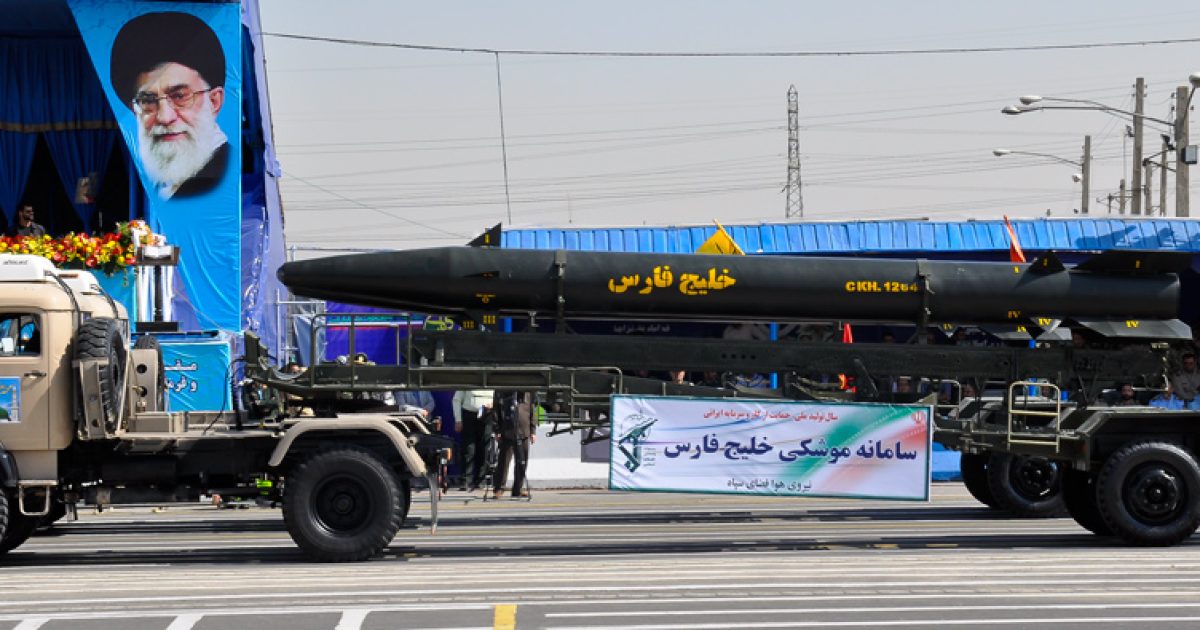


Iran has threatened to completely close the Strait of Hormuz and strike energy and desalination infrastructure across the region. Colonel Ebrahim Zolfaqari, spokesman for Iran’s Khatam al-Anbiya military command headquarters, warned that if Iran’s fuel infrastructure is attacked, all energy, information technology systems, and desalination infrastructure used by America and its allies in the region will be struck.
Parliament Speaker Mohammad-Bagher Ghalibaf echoed the threat on X, warning that critical infrastructure, energy, and oil across the region will be irreversibly destroyed and oil prices will remain elevated for a prolonged period if Iran’s power plants are struck. A UN official warned that Iran is poised to strike desalination plants across the region within days, which would trigger a water crisis affecting Gulf states and Israel.
The IRGC-affiliated Mehr news agency released a map showing power plants across the UAE, Saudi Arabia, Qatar, and Kuwait that could be targeted, with the message “Say goodbye to electricity!” IRGC-affiliated media also circulated a map marking Doha, including the headquarters of Al Jazeera, as a potential target, advising residents of the Qatari capital to evacuate.
Iran launched two ballistic missiles at the joint U.S.-UK base at Diego Garcia in the Indian Ocean, approximately 2,000 miles from Iran. Iranian Foreign Minister Araghchi warned Britain that any permission granted to the United States to use its bases for operations against Iran would be regarded as a direct act of aggression.
Some analysts see these threats as defiance, a sign that the IRGC refuses to surrender. Others view them as a desperate attempt to force a negotiated end to a war the IRGC cannot win, and the Islamic regime cannot survive.
Victor Davis Hanson, a senior fellow at the Hoover Institution and classicist and military historian at Stanford, has argued the tide has turned against Iran. He has written about how wars are won and lost, including in his book The Second World Wars, and has appeared on Fox News and The Daily Signal since Operation Epic Fury began. He has said Iran’s leadership could fall within weeks if the military campaign continues uninterrupted.
Hanson’s argument rests on reading the behavior of third parties rather than the claims of either side. In Europe, the E3, the United Kingdom, France, and Germany, resolved to support proportionate defensive military measures against drones and ballistic missiles, and British Prime Minister Keir Starmer said the United States can use British bases for defensive strikes on Iran. Hanson argues this signals that Europe has read the battlefield and aligned with the winning side.
While parts of Europe are coming around, other countries still refuse to help. Spain’s Prime Minister Sánchez called the war an error and withdrew Spain’s ambassador to Israel.
In the Gulf states, Saudi Arabia’s Foreign Ministry said Iran’s targeting of its sovereignty, civilian infrastructure, and diplomatic missions constituted a clear violation of international law. In a March 17 letter to the US-UAE Business Council, UAE Ambassador Yousef Al Otaiba said the investment pledges announced the previous year would continue without disruption, with plans to accelerate deployment and increase funding.
Al Otaiba noted that Iran had launched nearly 2,000 missiles and drones at the UAE, with more than 93 percent intercepted, and that ports and airports had reopened quickly. A top UAE presidential adviser said Iran had miscalculated in targeting Gulf countries, arguing the attacks would push the region toward the US.
Al Jazeera published an op-ed headlined “The US-Israeli strategy against Iran is working,” arguing that critics were measuring the wrong things by cataloging costs while ignoring the strategic ledger. The author, Muhanad Seloom, an assistant professor at the Doha Institute for Graduate Studies, wrote that every aspect of Iran’s ability to project regional power is being degraded and collapsing in real time. He added that air defenses had been suppressed to the point where the US is flying non-stealth B-1 bombers over Iranian airspace.
On the military situation, Chairman of the Joint Chiefs of Staff General Dan Caine confirmed on March 19 that A-10 fighters and AH-64E Apache helicopters are operating over Iran’s southern coast, hunting and killing fast-attack watercraft in the Strait of Hormuz. The US declared localized air superiority over the southern flank of the Iranian coast by March 4. This is significant because slow, low-flying platforms are only deployed when air defenses have been suppressed.
Hanson has written that Iran’s strategy is to drag out the conflict and hope that domestic criticism, the looming midterms, rising gas prices, and pressure from allies force the United States to end the war before the regime falls.
White House Press Secretary Karoline Leavitt said on March 15 that Iran’s missile capability is down 90 percent and its drone capability is down 95 percent since the start of the war. However, Al Jazeera hypothesized that Iran may be rationing its remaining missile capacity for politically timed salvos rather than maintaining a sustained operational tempo.
Hanson has said the timeline for regime collapse, if Trump sees the campaign through, is two, three, or four weeks. Of course, this is his opinion, and events may unfold differently. What is clear is that the Iranian regime appears to be weakening, while more U.S. allies are shifting their positions, becoming less critical of the United States, and signaling that they may provide some form of assistance or hold Iran accountable.
The post Iran Ramps Up Threats as Tide Turns Against the IRGC appeared first on The Gateway Pundit.