
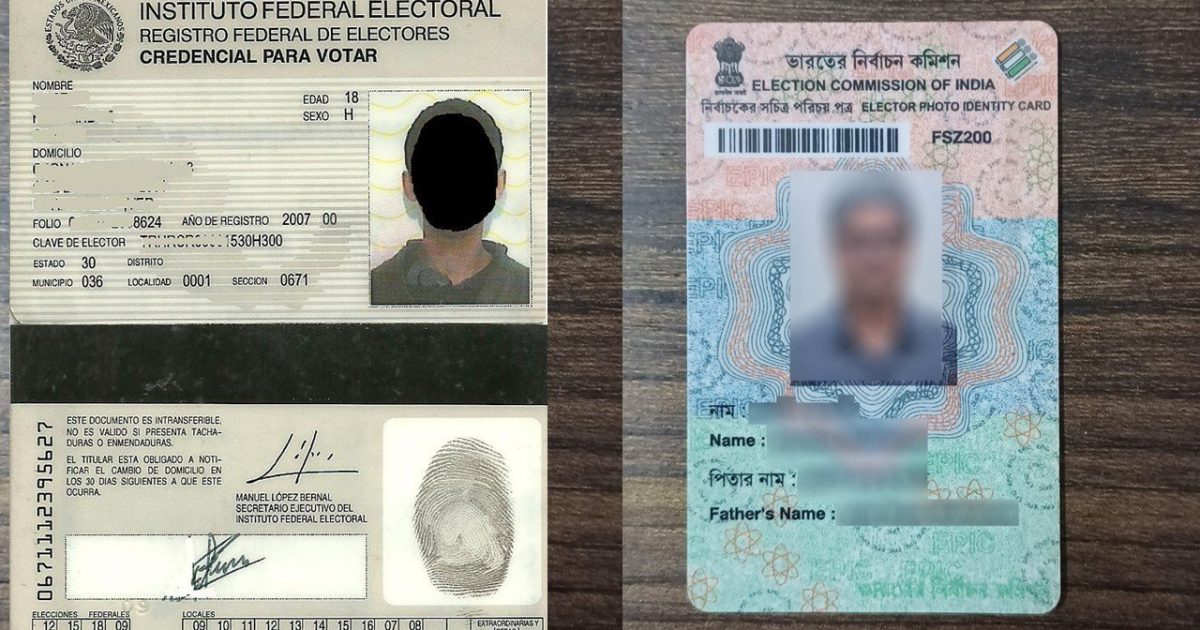


The Democrats oppose voter ID laws and are in favor of mail-in voting, while calling Republicans fascists for not agreeing with them.
However, a review of voting laws around the world shows that the overwhelming majority of countries, at least 176 nations and jurisdictions, require voter ID.
Many have no mail-in voting at all, while others allow only very limited domestic mail-in voting restricted to those who are hospitalized, and no country allows illegal aliens to vote.
While a small number of countries permit long-term legal residents to vote in local elections under strict residency conditions, even fewer allow non-citizen residents to vote in national elections.
No countries besides the United States allow jurisdictions, states, provinces, or cities to prohibit poll workers from asking voters for ID.
Most other democracies use automatic civil registration through national ID systems, making same-day walk-in voter registration an unknown concept abroad.
No nations accept ballots days or weeks after an election, regardless of postmark date. None allow ballot harvesting. Very few nations grant birthright citizenship, only around 33 countries, and most of these require at least one parent to be a citizen or permanent resident. Many also restrict passing naturalized citizenship to children if both parents are non-nationals.
According to the International Institute for Democracy and Electoral Assistance (IDEA), 34 countries or territories allow mail-in voting.
Of those, 12 allow all voters to vote by mail, while 22 permit only some voters to do so. And over 100 countries allow some form of out-of-country postal voting, though specifics vary greatly.
Countries that have banned or restricted mail-in voting due to fraud concerns include France (banned in-country postal voting in 1975), Mexico (banned in 1991, partially restored in 2006), and Belgium (banned domestic mail-in voting in 2018).
Russia does not allow mail-in voting for citizens abroad or residents.
Sweden and Italy do not permit mail-in voting. Ukraine does not permit it either. Canada, the UK, and Switzerland require application or registration before receiving a mail ballot. Switzerland mails ballots to all registered voters but requires ID and a polling card for anyone who then votes in person.
All-postal voting, in which all electors receive ballots by post without requesting them, is used in several U.S. states, and Switzerland. Outside these narrow examples, no comparable democracy routinely mails unsolicited ballots to all registered voters as standard national practice.
Only four countries in the world currently grant equal voting rights to foreigners in national elections: New Zealand, Chile, Malawi, and Uruguay. In New Zealand, permanent residents can vote after one year of residence. Chile allows legally present foreign-born adults to vote after five years, while Malawi requires seven years and Uruguay eight years.
Some countries permit noncitizen voting only in limited contexts. Ecuador allows legally present noncitizens to vote after five years, and Norway allows foreign nationals to vote in local elections after three years of residence.
Non-citizens cannot vote in national elections or referenda in Finland, Ireland, Belgium, Luxembourg, or Sweden — only in local elections under specific residency conditions.
Of the 47 nations in Europe, all but one require a government-issued photo ID to vote. Among the 38 member nations of the OECD, 33 require government-issued photo ID at the polls. The requirement spans every continent and nearly every style of government.
The four OECD member countries that did not require a photo ID were the United Kingdom, Australia, Japan, and New Zealand. Japan instead uses barcode-verified voter tickets, while Australia does not require any ID. New Zealand does not require ID for voting, but a New Zealand driver’s license, passport, or a RealMe-verified identity is required to enroll online. The United Kingdom has since introduced photo ID requirements for most elections.
No other democratic nation has a system comparable to certain U.S. states where jurisdictions are actively prohibited from asking voters for ID, and where ID-free voting is codified as a legal protection rather than an administrative default. California law prohibits poll workers from asking for voter ID for in-person voting. A Kern County elections official stated it plainly: “Poll workers should never be asking for an ID.”
Governor Newsom reinforced this at the state level. California’s Senate Bill 1174 prohibits local governments from requiring voters to present identification when casting ballots at the polls. When Huntington Beach attempted to require ID anyway, a California appeals court ruled that the measure violated state law.
In Canada, same-day registration is permitted. Since 2012, voter registration in Chile is automatic. Denmark also allows same-day corrections to voter rolls. Most other democracies do not need same-day registration because they use automatic or compulsory registration systems.
In Argentina, Chile, Hungary, Israel, the Netherlands, and elsewhere, voter registration is automatic, based on government records such as census counts. In Germany, all residents must register their address with local authorities; anyone turning 18 before an election is automatically added to voter rolls with no separate registration required.
Automatic voter registration tied to driver’s licensing is primarily an American debate; most peer democracies already register voters through population registers and have no need for a DMV trigger.
The only country other than the United States that provides automatic voter registration tied to a driver’s license is Canada. If a citizen applies for a driver’s license in a new province and checks a box allowing data sharing, provincial motor vehicle registrars can transfer their information to federal election authorities, automatically updating voter registration without any further action.
Ballot harvesting, gathering and submitting completed absentee or mail-in ballots by third-party individuals, occurs in some U.S. states where voting by mail is common, but some states have laws restricting it. As of July 2020, 26 states allow specified agents to collect and submit ballots for another voter.
There is no documented peer democracy with a system equivalent to unrestricted ballot harvesting as practiced in California. Most countries that allow absentee voting require ballots to be returned directly by the voter or a strictly defined family member. The vast majority of countries ban absentee ballots for people living in their country. While some European countries allow proxy voting, the safeguards used to prevent fraud are generally far more stringent than those used for absentee ballots in the U.S.
Regarding post-election ballot acceptance: In the U.S., five states had a receipt deadline between one and four days after the election; seven states and D.C. had a deadline between five and ten days after Election Day; two states, Illinois and Washington, had a deadline between 14 and 20 days after the election. Every state that accepts ballots after Election Day requires that the ballot carry a postmark on or before Election Day.
California accepts mail ballots received up to 22 days after Election Day, provided they are postmarked by Election Day. In Canada, roughly 99,988 special ballots in the 2021 election were not counted because they arrived after the receipt deadline of 6 p.m. on election day. No comparable democracy accepts ballots arriving 30 days after an election.
According to the CIA World Factbook, at least 33 countries provide automatic citizenship to anyone born within their borders. Virtually every nation that offers unconditional birthright citizenship is located in North or South America, a pattern traced to colonial-era European policies designed to populate New World settlements.
Australia and New Zealand formerly had unconditional birthright citizenship but both shifted to conditional systems between the 1980s and 2000s. Today, children born there qualify only if at least one parent is a citizen or permanent resident.
Most European, Asian, and African countries follow jus sanguinis principles. Germany and France offer citizenship to children born on their soil only if their parents meet certain residency or legal-status requirements.
Canada is one of the few countries outside the United States that adheres to unconditional birthright citizenship. Under Canada’s Citizenship Act, a child born in Canada is granted citizenship even if neither parent is a citizen or permanent resident, provided neither parent is a diplomat. The nationality or immigration status of the parents does not matter. However, there is active political pressure to change this, with some Conservative Party members seeking to end birthright citizenship for the children of tourists and illegal aliens.
Mexico and most Latin American nations also extend birthright citizenship with no parental-status requirement. Article 30 of Mexico’s Constitution states that persons born in Mexican territory are natural-born citizens regardless of their parents’ nationality. Outside the Americas, this unconditional extension of birthright citizenship to children of undocumented immigrants is rare to nonexistent among developed nations.
Given the restrictions imposed on voting and immigration in other countries, by liberal standards, it is not just Trump but the whole world that qualifies as Fascists.
The post Voting Laws Around the World – Most Countries Require ID, No Illegal Aliens, and No Ballot Harvesting appeared first on The Gateway Pundit.