
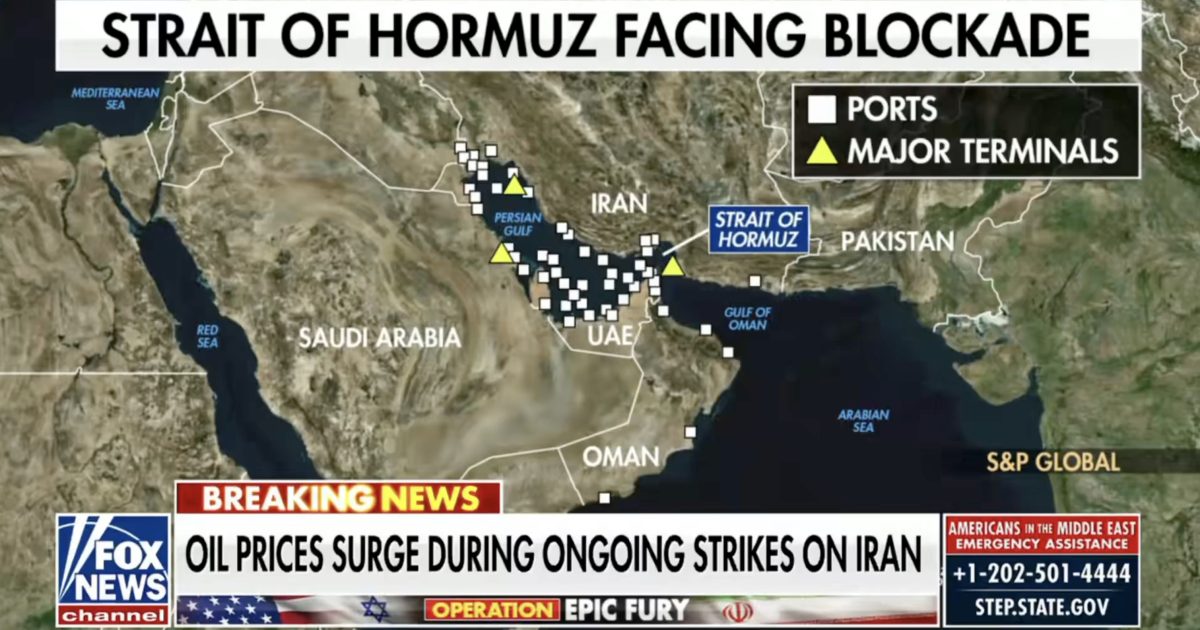


President Donald Trump is urging commercial oil tankers to push through the strategic Strait of Hormuz despite escalating tensions with Iran, declaring that there is “nothing to be afraid of” after U.S. military strikes severely weakened the Iranian regime’s naval capabilities.
The blunt message from the commander-in-chief came as global energy markets reacted to the ongoing conflict between the United States, Israel, and Iran.
Oil prices exploded over 17% on Sunday, blasting past the $100 per barrel mark for the first time since the early days of Trump’s decisive strikes against the Iranian regime.
In a bold Truth Social post this evening, Trump dismissed the short-term pain as a necessary step toward crushing the Iranian nuclear threat once and for all.
“Short term oil prices, which will drop rapidly when the destruction of the Iran nuclear threat is over, is a very small price to pay for U.S.A., and World, Safety and Peace. ONLY FOOLS WOULD THINK DIFFERENTLY!”
In a fiery statement during an interview with Fox News’ Brian Kilmeade, Trump called on ship operators and tanker crews to continue moving oil shipments through the critical maritime chokepoint.
Kilmeade relayed the message on Fox & Friends:
He says, ‘Tell these tankers to get themselves, get to it, we have wiped out most of their launchers.’ Here is exactly what he said: ‘These ships should go through the Strait of Hormuz and show some guts, there’s nothing to be afraid of. [The Iranians] have no navy, we sunk all their ships.’
He went on to say: ‘Look, there is risk in the region, the region is volatile, their launchers, there’s just about 150 left, that’s just about 20% of totals, they can’t regenerate, they can’t make any more. We are in the region and need to act quickly on all these type of attacks.’
WATCH:
President Donald Trump said the U.S. military has “knocked out” 42 Iranian naval vessels and crippled much of Iran’s air force, while addressing Latin American leaders at the Shield of the Americas Summit in Florida on Saturday.
“We are doing very well in Iran, you see the result,” he says. “Its been amazing, we’ve knocked out 42 navy ships, some of them very large, in three days. That was the end of the navy.”
Now, new reports indicate that some commercial vessels are switching off their transponders, briefly going “dark,” while transiting the Strait of Hormuz, only to turn them back on after safely passing through the strategic waterway.
Maritime tracking data suggests ships are temporarily disabling their Automatic Identification System (AIS) signals, a move that effectively makes them invisible to public tracking platforms during the most sensitive portion of their journey.
BBC reported:
Widespread signal interference and disabled transponders have made real-time tracking of ships difficult around the Strait of Hormuz. This gap in reporting prevents consistent daily oversight, as ship locations often remain unknown until they reappear on satellite feeds days later.
Because vessels can move without AIS signals until they are well away from Hormuz, automated position signals were compiled over a large area covering the Gulf of Oman, the Arabian Sea and the Red Sea to detect those that may have departed or entered the Persian Gulf.
When potential transits are identified, signal histories are examined to determine if the movement appears genuine, or are the result of spoofing — where electronic interference can falsify the apparent position of a ship.
Some transits may not have been detected if vessels’ transponders haven’t been switched back on. Iran-linked oil tankers often steam from the Persian Gulf without broadcasting AIS signals until they reach the Strait of Malacca about 10 days after passing Fujairah. Other ships may be adopting similar tactics and won’t show up on tracking screens for many days.
Ships are reportedly crossing the strait of Hormuz. They are reportedly turning off their transponders before passing through, and switch them back on afterward.
pic.twitter.com/hbq9gsRvyk
— Breaking911 (@Breaking911) March 9, 2026
The Strait of Hormuz is one of the most strategically important waterways in the world. Roughly one-fifth of the global oil supply moves through the narrow passage between Iran and Oman.
The president has acknowledged that the war could bring short-term economic pain, including higher fuel prices, but insists the stakes are far bigger than temporary market volatility.
Trump argues the campaign against Iran is necessary to dismantle the regime’s nuclear ambitions and terrorist networks, warning that allowing Tehran to dominate the region would pose a far greater threat to global stability.
The post TRUMP TO OIL TANKERS: “SHOW SOME GUTS!” – President Says Iran’s Navy Is Finished, Urges Ships to Sail Through Strait of Hormuz appeared first on The Gateway Pundit.