
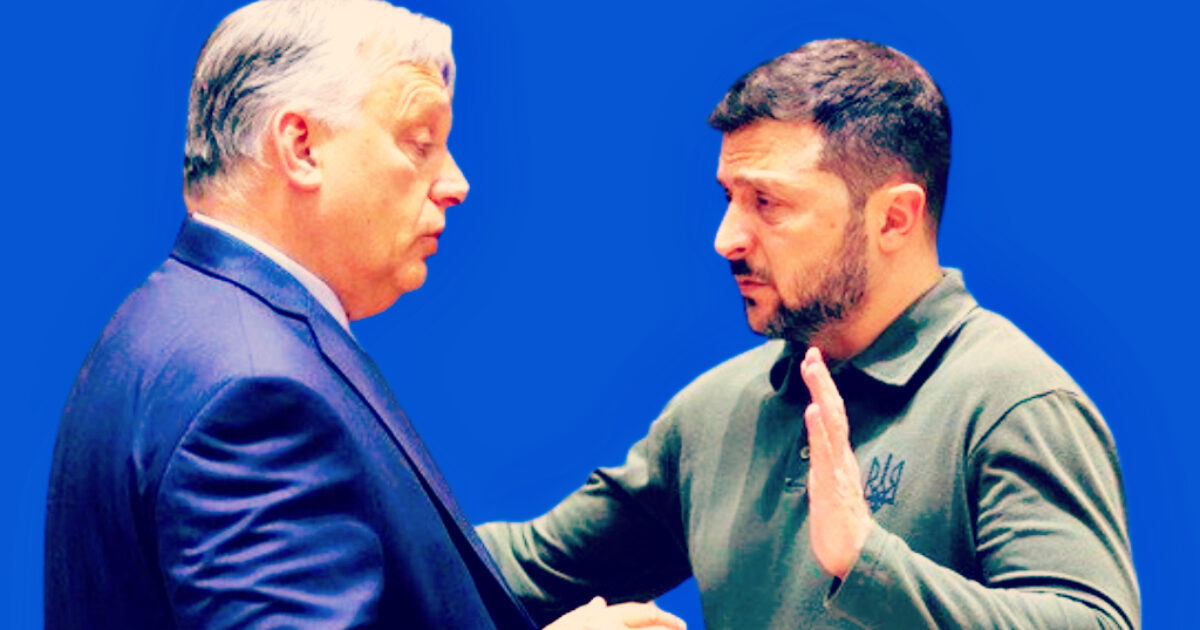

A diplomatic storm erupted this week after Ukrainian President Volodymyr Zelensky made remarks widely interpreted as a threat against Hungarian Prime Minister Viktor Orbán—drawing exceedingly rare cross-spectrum condemnation from both national-conservative, anti-globalist critics of Kyiv as well as pro-EU establishment figures in Brussels who have otherwise been among Zelensky’s strongest supporters.
During a press briefing in Kyiv, covered earlier this week in a report by The Gateway Pundit, Zelensky suggested that the contact details of those responsible for blocking the funds could be handed to Ukrainian soldiers. He stated that Ukrainian troops could “call [Orbán] and speak to him in their own language”—the language of the military—a clear allusion to the language of violence.
WATCH: Zelensky Casually Threatens to Unleash Ukrainian Military on Hungary’s Viktor Orbán for Blocking €90 billion EU Aid
Zelensky issues dire threat to Hungarian PM Orbán if he continues to block €90 billion in loans to Ukraine.
“We hope this one person [Orban] in the EU will not block €90 billion aid. Otherwise, we will give this person’s address to our armed forces.”pic.twitter.com/ayoSJlDCEs
— Remix News & Views (@RMXnews) March 5, 2026
Hungarian officials immediately condemned the statement as intimidation. Government spokesperson Zoltán Kovács said Zelensky’s comments “went far beyond every acceptable limit.”
“When someone threatens to give a person’s address to Ukrainian soldiers simply because they refuse to support another €90 billion weapons package, that is not diplomacy—it is an open threat,” Kovács said.
Iuliia Mendel, a former spokeswoman for the Ukrainian presidency, even took the opportunity to sharply rebuke Zelensky over his inflammatory remarks targeting Orbán. Mendel warned that the arrogance and political blackmail now associated with Kyiv’s leadership were not features of Ukrainian diplomacy before Zelensky came to power, arguing that such behavior is only accelerating the country’s diplomatic isolation.
In a social media post, she cautioned that Zelensky’s confrontational rhetoric is damaging Ukraine’s position at a time when the country remains heavily dependent on foreign money and weapons. According to Mendel, Kyiv’s repeated clashes with Orbán—marked by pressure tactics and public insults—have become a serious strategic blunder.
“Specifically in relation to the comments made by President Zelenskyy, we are very clear as the European Commission that that type of language is not acceptable. There must not be threats against EU member states,” Commission deputy chief spokesperson Olof Gill told reporters… pic.twitter.com/f92K3dcy52
— Iuliia Mendel (@IuliiaMendel) March 6, 2026
The dispute comes amid worsening relations between Hungary and Ukraine, particularly after Kyiv halted Russian oil transit through the Druzhba pipeline to Hungary and Slovakia in January. In response, Budapest has threatened to block a €90 billion EU loan package for Ukraine as well as the bloc’s 20th sanctions package against Russia, further exposing the growing rift between nationalist governments defending their interests and Kyiv’s increasingly confrontational leadership.
The remarks triggered a rare rebuke from the European Commission, which warned Kyiv that threatening language directed at EU member states was unacceptable. Commission deputy chief spokesperson Olof Gill told reporters that Zelensky’s rhetoric crossed a line.
“We are very clear as the European Commission that this type of language is not acceptable,” Gill said. “There must not be threats against EU member states.”
This was a big diplomatic mistep for Zelenskyy. I get his frustration with Orbán — but keep a cool head!
“We are very clear that that type of language is not acceptable. There must not be threats against EU member states,” the EU Commission said.https://t.co/URKib4k8Vm
— Hans von der Burchard (@vonderburchard) March 6, 2026
The dispute reflects mounting tensions between Kyiv and Budapest, which have been locked in a bitter standoff over energy supplies, financial aid, and Ukraine’s ambitions to join the European Union.
At the center of the conflict is the Soviet-era Druzhba pipeline, which transports Russian crude oil through Ukraine to Hungary and Slovakia. Hungary has accused Kyiv of deliberately halting the flow of oil through the pipeline earlier this year.
Budapest says the shutdown has driven up fuel prices and threatens energy security for Hungarian families. Ukraine denies the accusation, claiming the pipeline was severely damaged by a Russian drone attack.
Orbán has made it clear that restoring the pipeline is a non-negotiable priority for Hungary. Writing on social media, the Hungarian leader declared that his government would take decisive action to defend its national interests.
“There will be no deals, no compromise,” Orbán said. “We will break the Ukrainian oil blockade by force. Hungary’s energy will soon flow again through the Friendship pipeline.”
Hungarian Foreign Minister Péter Szijjártó echoed the prime minister’s stance, accusing Kyiv of attempting to blackmail Hungary into supporting the loan package.
“No one can threaten Hungary or its prime minister,” Szijjártó said. “No one can blackmail us simply because we refuse to pay the price of Ukraine’s war.”
“I am not looking for trouble with the Ukrainians, but did President Zelensky expect us to sit quietly and twiddle our thumbs? Ukraine has blocked our oil from reaching Hungary. We cannot and will not accept this. Their plan is blackmail. My plan is resilience. Reopen the pipeline now,” Orbán wrote on X.
I am not looking for trouble with the Ukrainians, but did President @ZelenskyyUa expect us to sit quietly and twiddle our thumbs? Ukraine has blocked our oil from reaching Hungary. We cannot and will not accept this. Their plan is blackmail. My plan is resilience. Reopen the… pic.twitter.com/UV7Limrfps
— Orbán Viktor (@PM_ViktorOrban) March 7, 2026
Across Europe, nationalist, anti-globalist, and sovereignty-focused politicians rallied behind Orbán, warning that Zelensky’s rhetoric reflects growing arrogance from a government that has already received massive financial support from European taxpayers.
The Patriots for Europe group in the European Parliament issued a statement condemning what it described as intimidation directed at a sovereign EU member state. The group stressed that such behavior undermines Ukraine’s claims that it shares the democratic values required for EU membership.
“Statements suggesting intimidation or threats of violence are incompatible with democratic principles,” the group said.
<blockquote class=”twitter-tweet”><p lang=”ro” dir=”ltr”> | Zelensky’s threats against Prime Minister Viktor Orbán are unacceptable.<br><br>Read our statement: <a href=”https://t.co/L8lx6UHE5P”>pic.twitter.com/L8lx6UHE5P</a></p>— Patriots for Europe (@PatriotsEP) <a href=”https://twitter.com/PatriotsEP/status/2029650825350418529?ref_src=twsrc%5Etfw”>March 5, 2026</a></blockquote> <script async src=”https://platform.twitter.com/widgets.js” charset=”utf-8″></script>
Members of the Europe of Sovereign Nations (ESN) alliance also voiced strong support for Hungary. Many warned that Brussels’ continued unconditional backing for Kyiv risks further destabilizing the European Union.
Austrian Freedom Party MEP Harald Vilimsky delivered one of the most direct responses to Zelensky’s comments.
“Not another euro for Zelensky and his corrupt gang,” Vilimsky said. “We stand with Hungary.”
Polish MEP Ewa Zajączkowska-Hernik argued that Orbán’s stance is motivated by a simple obligation to protect his country’s citizens.
“Hungary did not take this step out of whim,” she said. “Ukraine halted oil transit through the Druzhba pipeline, causing fuel prices to rise. Prime Minister Orbán is simply defending Hungarian families.”
Spain’s Vox MEP Hermann Tertsch suggested that Kyiv’s actions may be part of a broader attempt to interfere in Hungarian domestic politics ahead of national elections.
“Zelensky has allowed himself to be used by Brussels to interfere in the Hungarian election campaign,” Tertsch said. “It is very likely that their plan will backfire.”
Slovak Prime Minister Robert Fico also entered the debate later on Thursday, publishing a video message on social media in which he voiced “full solidarity” with Hungary’s leader. Fico warned that if President Zelensky continues using such rhetoric, other EU governments may also reconsider their support for the proposed €90 billion financial package for Ukraine.
REACTION OF THE PRIME MINISTER OF THE SLOVAK REPUBLIC, ROBERT FICO, TO THE BLACKMAILING BEHAVIOR OF UKRAINIAN PRESIDENT ZELENSKYY
I express full solidarity with the Prime Minister of Hungary, @PM_ViktorOrban. If the Ukrainian president continues like this, it may happen that… pic.twitter.com/NLKfyZPZ1j
— Robert Fico
(@RobertFicoSVK) March 5, 2026
The dispute escalated further after Hungarian authorities detained seven Ukrainian employees of a state bank transporting large quantities of cash and gold through Hungary. Officials linked the detentions to suspected money-laundering activity.
Kyiv responded furiously, accusing Hungary of “state terrorism” and threatening sanctions in retaliation.
Meanwhile, European Council President Antonio Costa has reportedly begun efforts to mediate between the two governments in an attempt to prevent the crisis from spiraling further out of control.
Brussels fears that continued confrontation could jeopardize the €90 billion loan package, which Ukrainian officials argue is critical to sustaining Kyiv’s war effort.
Ukraine is expected to face severe financial shortfalls in the coming months, and EU leaders have pledged to provide additional funding to keep the Ukrainian government afloat.
But Orbán has repeatedly argued that endless financial transfers to Kyiv are unsustainable and risk dragging Europe deeper into a costly geopolitical conflict.
The post EU, Ex-Zelensky Spokeswoman, and Conservative Anti-Globalists Condemn Zelensky’s Unhinged “Armed Forces” Threat to Orbán appeared first on The Gateway Pundit.