
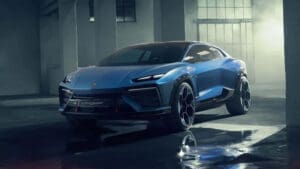

Lamborghini has abandoned plans to launch a fully electric model, shelving its much-anticipated Lanzador in favour of expanding its plug-in hybrid line-up.
Chief executive Stephan Winkelmann said demand for battery-powered supercars among the brand’s wealthy clientele was “close to zero”, warning that continued investment in EV development risked becoming “an expensive hobby”.
The Lanzador, unveiled as an all-electric concept in 2023, was expected to form Lamborghini’s fourth EV project. Instead, it will now be replaced by a plug-in hybrid electric vehicle (PHEV), meaning the company’s entire range will be hybrid by 2030.
Winkelmann said Lamborghini would continue producing internal combustion engines “for as long as possible”, arguing that customers value the “emotional experience” of the brand’s cars — from design and performance to the distinctive engine sound.
“EVs, in their current form, struggle to deliver this emotional connection,” he said.
Lamborghini, owned by Audi and part of the Volkswagen Group, delivered a record 10,747 vehicles in 2025, marking its second consecutive year above 10,000 units.
Its current range, including the Urus SUV, Temerario sports car and Revuelto supercar, is already fully PHEV. The Urus, accounting for around 60 per cent of total sales, remains the backbone of the business.
While Europe and the Middle East remain strong markets, deliveries in the Americas declined nearly 10 per cent last year.
Winkelmann said the decision to cancel the Lanzador followed more than a year of discussions with dealers and customers. “Investing heavily in full EV development when the market and customer base are not ready would be financially irresponsible,” he said.
Lamborghini’s move reflects broader challenges facing carmakers in the transition to electric vehicles. Lower-than-expected consumer demand and rising development costs have led several manufacturers to scale back EV ambitions.
Stellantis recently announced significant write-downs linked to electric programmes, while Ford Motor Company and General Motors have also disclosed multibillion-dollar charges.
However, not all luxury brands are retreating. Rolls-Royce’s Spectre EV has emerged as one of its most popular models, suggesting electric adoption varies significantly by segment.
In the UK, petrol and diesel car sales are due to end by 2030, while the EU plans a 2035 phase-out of most new combustion engine vehicles. As a low-volume manufacturer, Lamborghini currently benefits from exemptions under emissions rules and intends to seek extensions beyond 2035.
Winkelmann noted that Lamborghini vehicles typically cover relatively low annual mileage, less than 2,000 miles for supercars, limiting their environmental footprint.
“Never say never,” he said of a future EV. “But only when the time is right.”
For now, the Italian marque is betting that hybrid technology offers the best balance between regulatory compliance and preserving the visceral appeal that underpins its brand.
Read more:
Lamborghini scraps electric supercar plans and doubles down on hybrids