


Liberals and Democrats always attack Republicans, saying that they do not care about and do not help the homeless. Of course, homelessness did not disappear under Obama, and it skyrocketed under Biden, suggesting that fixing the homeless problem is more difficult than critics make it seem and that the left does not have a better solution.
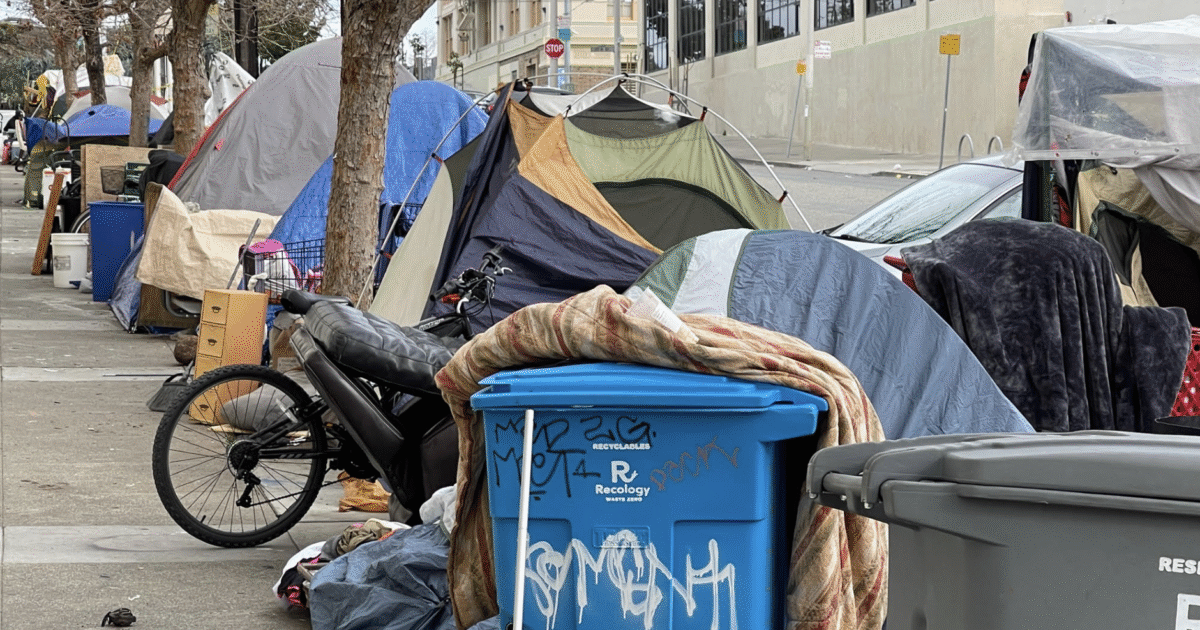
When President Trump returned to office, he inherited a country not only overrun with Biden-era illegal aliens but also teeming with drug-addicted homeless, making large chunks of cities like San Francisco and Philadelphia effective no-go zones, populated by fentanyl zombies and homeless encampments. Along with the unhygienic and disorderly conditions of the areas occupied by the homeless, these encampments are also rife with crime, particularly drugs, prostitution, robbery, and violent crimes.
The statistics on homelessness vary widely and are often intentionally misrepresented to support a political agenda. According to HUD, 771,480 people experienced homelessness in an emergency shelter, safe haven, transitional housing program, or unsheltered location across the country at some point during the year. Many of these individuals are already within the system, suggesting that the number of people living literally on the streets is smaller than headline figures imply.
The conventional belief has always been that people living on the street suffer from mental illness and or drug and alcohol addiction and would be unemployable without treatment. This means that simply giving them free housing would not solve the problem. In order to promote their housing-first approach, liberals find themselves in a difficult position.
They must downplay addiction and mental health numbers enough to support claims that providing free housing would solve homelessness, while simultaneously promoting the mental health and drug addiction narrative to demand funding for voluntary treatment programs.
As a result, studies on the number of homeless people, the percentage addicted to drugs and alcohol, and the percentage suffering from mental illness are manipulated to support the political narrative of the day. Some studies claim the rate of alcohol and drug addiction is as low as 25 percent, which is not only counterintuitive but conflicts with reports showing that 68 percent of cities identify substance abuse as the largest cause of homelessness among single adults. Other studies have found that 75 percent of the homeless are drug addicts.
According to a 2024 Journal of the American Medical Association analysis, 67 percent suffer from some form of mental health disorder, while other studies have determined that roughly 75 percent of the homeless suffer from either mental health issues or substance abuse problems severe enough to make them unable to work without treatment.
To address the problem, President Trump’s July 24, 2025, executive order, “Ending Crime and Disorder on America’s Streets,” directs federal agencies to shift homelessness policy toward civil commitment and court-supervised treatment for people with serious mental illness or addiction. The order promotes the appropriate use of civil commitment to move homeless individuals into institutional settings and expands assisted outpatient treatment and drug courts.
President Trump’s approach can be described as treatment-first or recovery-first. It differs from housing-first by requiring sobriety, treatment compliance, or other behavioral changes before permanent housing is provided. The model emphasizes institutional or structured treatment settings, including psychiatric facilities, and relies on civil commitment through legal mechanisms for individuals deemed dangerous or unable to care for themselves.
It requires participants to receive treatment and demonstrate stability before earning permanent housing. This approach addresses root causes, specifically mental illness and addiction, while promoting recovery and long-term self-sufficiency.
Liberals oppose the treatment-first model because it requires the homeless to take responsibility for their lives. They describe it as re-institutionalization, involuntary commitment, forced treatment, and a return to pre-1960s psychiatric hospitalization. Their position is that adults have the right to choose drug or alcohol addiction if they wish and that the state does not have the right to mandate morality or behavior.
Conservatives would argue that while individuals may have that right, taxpayers should not be paying rent for people who choose drugs and alcohol rather than work.
Treatment-first assumes that taxpayer expenses are temporary. As people receive treatment and overcome addiction, they can transition into work and self-support. Under the liberal housing-first model, the homeless never make that transition, requiring taxpayers to subsidize them indefinitely.
To vilify the treatment-first model, liberal media outlets have drawn parallels between forced institutionalization and Hitler. Liberals on social media platforms such as Twitter and Instagram have amplified this narrative, claiming that institutionalization is only the first step and that the administration will eventually have these people killed, as Hitler did with the disabled.
A July 2025 Mind-War Blog article titled “Taking Aktion: Trump’s Plan to Disappear the ‘Work-Shy’” argued, “This is a carbon copy of Aktion T4, the eugenics and ‘euthanasia’ program that represented the initial test for the Holocaust; and Aktion Arbeitsscheu Reich, a campaign to eliminate the ‘work-shy.’” The article claimed Trump wants to “take away the 1st and 4th Amendment for people that they deem to be ‘unfit.’”
In July 2025, Truthout published a post by public health educator Azrael Mae Ní Mháille stating, “Calls for a return of the violently ableist asylum system, or the continued restrengthening of the deeply racist post-emancipation anti-vagrancy laws, stop just short of calling for a return to legalized chattel slavery, or for a new Aktion T4.” The article noted that online commentary had already compared the executive order to the earliest chapters of the Nazi Holocaust.
Earlier, in August 2022, Defense One published an article titled “Trump Wants Concentration Camps and Presidential Control of Domestic Troops,” which framed Trump’s proposal to round up homeless people and place them in camps on cheap land in similar terms.
As with many other issues, liberals create a nightmare scenario, buy into it, amplify the messaging, and then protest in favor of policies they claim are necessary to prevent this fictitious outcome from becoming reality. At the same time, they demand more funding, which perpetuates the problem.
The new affordable housing development in downtown Baltimore, Sojourner Place at Park, is an example of the housing-first liberal alternative, which began in the 1990s and was continued under Obama and Biden when housing-first became the dominant federal approach. Under this model, people receive immediate access to housing without preconditions. They do not have to be sober, employed, or in treatment to qualify, and supportive services such as mental health treatment, addiction counseling, and job training are voluntary.
The $28 million project will include 42 units locked in at affordable rates for 40 years, with 28 designated as permanent supportive housing that combines reduced rent with ongoing services. The development is funded through Low Income Housing Tax Credits and private foundation grants.
The program incorporates a socialist policy of rent control, whereby tenants pay below-market rent or, in some cases, no rent at all, with the state either making up the difference to landlords or becoming the landlord itself.
Either way, it represents an unending expense for taxpayers. At the same time, it makes recovery voluntary, allowing people to remain housed while addicted to drugs and unemployed indefinitely. A further complication is that liberals are more hesitant than conservatives to force people into these programs, meaning those who choose to remain on the street without treatment or employment are free to do so. In the end, it does not solve the homelessness problem.
The post Liberals Compare Trump’s Plan Requiring Treatment or Work for Housing to the Holocaust appeared first on The Gateway Pundit.