
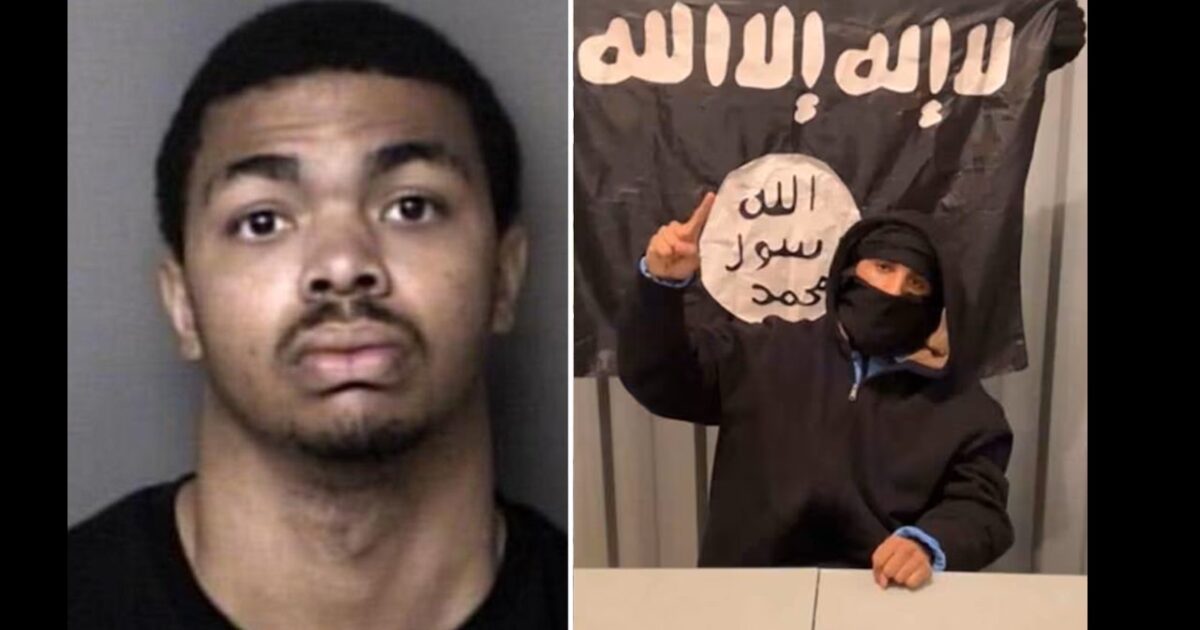


Federal authorities disrupted a planned ISIS-inspired New Year’s Eve attack in Mint Hill, North Carolina, arresting 18-year-old Christian Sturdivant on December 29, 2025. Officials said the intended targets were a grocery store and a fast-food restaurant. US Attorney Russ Ferguson confirmed Sturdivant was charged with attempting to provide material support to a foreign terrorist organization, which carries a maximum sentence of 20 years.
The FBI said Sturdivant first came to its attention in 2022, at age 14, after attempting to contact ISIS online and allegedly receiving guidance to carry out hammer attacks. No charges were filed at the time, and he received psychological care. In December 2025, investigators said he resumed threatening online activity, contacted undercover officers he believed were ISIS members, pledged allegiance to ISIS, requested help obtaining firearms, and shared images of knives and hammers.
A search of his home recovered weapons and handwritten plans titled “New Years Attack 2026,” listing tactical gear and describing efforts to maximize casualties. Officials said his intended targets included Jews, Christians, and LGBTQ individuals. Ferguson criticized a state magistrate judge’s earlier refusal to involuntarily commit Sturdivant despite reported threats. FBI officials said he was under constant surveillance, including over Christmas.
While ISIS and its splinter organizations continue expanding across Africa, Syria, and Iraq, ISIS-inspired attacks are increasing across the United States, Australia, Europe, the Middle East, and Asia. In 2025, this included the January 1 New Orleans truck attack, when Shamsud-Din Jabbar, a 42-year-old U.S. Army veteran, drove into crowds on Bourbon Street, killing 14 people, or 15 including himself, and injuring 57. Jabbar posted videos pledging ISIS support while en route, and investigators recovered IEDs at the scene.
Another ISIS-inspired attack occurred on December 14, when father and son Sajid Akram, 50, and Naveed Akram, 24, opened fire at a Hanukkah celebration on Sydney’s Bondi Beach, killing 15 people, including a 10-year-old child, and hospitalizing 42. Australian officials confirmed the attack was motivated by Islamic State ideology. The two had recently traveled to Mindanao in the Philippines, an ISIS-affiliated region, and authorities recovered two IEDs.
Other thwarted plots in 2025 included John Michael Garza Jr., 21, arrested in Texas on December 22 after providing bomb-making materials, cryptocurrency, and instructions to an undercover FBI agent. On October 31, multiple suspects were arrested in Dearborn and Inkster, Michigan, after discussing an ISIS-inspired attack in online chatrooms, conducting weapons training with AK-47s, and referencing “pumpkin day.” Muhammad Shahzeb Khan, a Pakistani national living in Canada, was extradited on June 10 for planning a mass shooting at a Jewish center in New York City. Nasir Ahmad Tawhedi, an Afghan national in Oklahoma City, pleaded guilty on June 13 to conspiring to carry out an ISIS-inspired Election Day 2024 attack after acquiring two rifles and 500 rounds of ammunition.
An ISIS-inspired attack involves individuals who self-radicalize through ISIS propaganda, primarily online, without direct operational contact with the organization. These attackers pledge allegiance to ISIS ideology, act independently rather than as part of a coordinated cell, and adopt tactics promoted in ISIS publications such as Rumiyah and Inspire. Radicalization occurs largely through digital exposure to propaganda, encrypted messaging platforms, social media channels, and videos glorifying ISIS violence.
ISIS publications provide explicit guidance on vehicle-ramming attacks, weapon selection involving knives or hammers, target selection focused on crowded public venues and religious gatherings, and basic operational security. Individuals absorb ISIS’s Salafi-jihadist worldview, internalize the belief that Western societies are enemies of Islam, and accept calls to attack “infidels” in their home countries. Recent conflicts, including the Gaza war, have intensified this process by fueling anger that ISIS exploits in its recruitment messaging.
Law enforcement identifies ISIS inspiration through pledges of allegiance in videos or audio recordings, ISIS symbols or flags at attack scenes, pre-attack statements proclaiming support, and written materials referencing ISIS ideology. Tactical indicators include vehicle-ramming attacks, knife assaults, IED placement, and target selection consistent with ISIS guidance. Digital footprints often show engagement with ISIS propaganda channels, downloads of ISIS publications, and online expressions of ideological support.
ISIS’s current strategy functions as a “Digital Caliphate,” allowing the organization to inspire attacks without controlling territory or maintaining direct contact with perpetrators. Propaganda acts as a force multiplier, with a single publication capable of motivating hundreds of attacks worldwide. This model offers deniability, low resource requirements, resilience to leadership losses, and increased difficulty for intelligence agencies to detect lone actors.
According to the Global Terrorism Index 2025 released in March, 93 percent of fatal terrorist attacks in the West over the past five years were carried out by lone wolves. Terrorist incidents in Western countries rose 63 percent, from 32 attacks in 2023 to 52 in 2024. Seven Western nations now rank among the world’s top 50 for terrorism: Germany, the United States, France, the United Kingdom, Australia, Canada, and Sweden.
The radicalization timeline has sharply accelerated. In 2002, it took an average of 16 months from initial exposure to extremist material to executing an attack. By 2015, that period had dropped by more than 40 percent. Today, radicalization can occur in weeks, driven by digital platforms that funnel vulnerable individuals toward increasingly extreme content.
Marc Polymeropoulos, a counterterrorism expert at the Atlantic Council, said authorities prefer investigating terrorist cells because cells offer opportunities to recruit informants, intercept communications, and exploit operational mistakes. Lone wolves eliminate those advantages. Self-radicalization occurs privately through online consumption, with no co-conspirators, no travel to training camps, no financial ties to known networks, and no communications with ISIS operatives to monitor.
The FBI has warned that lone offenders without a clear group affiliation or guidance are especially difficult to identify, investigate, and disrupt. Radicalization now occurs across social media, gaming platforms, and encrypted messaging apps, with algorithm-driven systems pushing users toward increasingly extreme content.
ISIS employs AI-enhanced videos and multilingual online magazines distributed through encrypted channels and dark web forums, while funding increasingly relies on cryptocurrency, leaving minimal financial trails for authorities to track.
FBI Director Christopher Wray testified multiple times in 2024 that he was “hard pressed to think of a time where so many threats to our public safety and national security were so elevated all at once.” Even before October 7, 2023, officials warned of heightened violence risks. After October 7, a “rogue’s gallery of foreign terrorist organizations” openly called for attacks, raising concern that individuals would draw what Wray described as “twisted inspiration” from events in the Middle East.
Authorities are increasingly concerned about the potential for a coordinated ISIS-K–style attack similar to the March 2024 Crocus City Hall massacre in Moscow that killed 145 people. In Europe, nearly two-thirds of ISIS-linked arrests in 2024 involved teenagers. In the United Kingdom, one in five terror suspects is now under 18, with 42 percent of the 219 terrorism arrests that year involving minors. Similar patterns have emerged in Australia, Austria, and France.
The New Orleans attack underscored the challenge. Jabbar had no prior known ties to extremist networks and was described by the FBI as “100 percent inspired by ISIS.” He self-radicalized online, acted entirely alone, and posted allegiance videos hours before the attack. FBI counterterrorism official Christopher Raia said the operation was “planned independently, driven by an ideological alignment with the Islamic State group rather than at the direction of any of its leaders,” noting authorities only learned of Jabbar’s radicalization after the killings.
The traditional detect, disrupt, deter counterterrorism model struggles against this threat because lone actors leave few signals. There are no communications to intercept, no travel to monitor, no financial transactions tying them to terrorist networks, and attacks often cannot be disrupted until preparations are nearly complete. Lone wolves willing to become “martyrs” are not deterred by punishment or consequences.
The FBI has acknowledged that it increasingly relies on tips from the public and online monitoring to stop these plots. Many thwarted attacks in 2025 were uncovered only after social media posts were flagged or suspects discussed plans in chatrooms infiltrated by FBI operatives, making prevention largely reactive and dependent on someone noticing and reporting suspicious behavior.
The post ISIS Inspired Attacks Are Increasing Globally: Why They’re So Hard to Stop appeared first on The Gateway Pundit.